How Does Power Work? A Look Inside Cate's Senate

By Serena Zhang '28
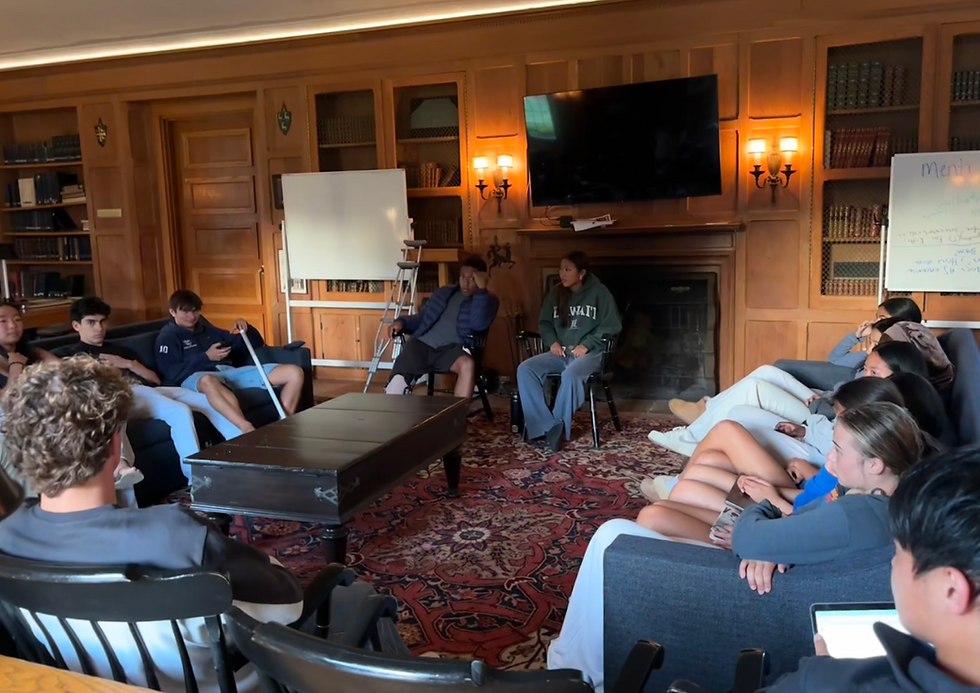
Every Tuesday night, students representing all grades gather in the Johnson Library, taking their seats around the table as Senate comes to order. This year, as Cate explores the school theme of "How Does Power Work?”, those meetings demonstrate how students exercise power every day. As Diversity, Equity, and Inclusion (DEI) representative Andrew Peng '26 states, “The mission of Senate is to bring Cate students a better experience, whether that be in academics, residential, student life, or as a whole in all aspects of their Cate experience.”
To illustrate the dynamics of Senate, sophomore senator Chelsea Newlove '28 and DEI representative Pari Malik '27 describe a meeting through the eyes of two Senate members: “We enter the room, and it often feels very busy, with students coming in during their free time on top of their schoolwork and other commitments. However, it is definitely productive and organized in the sense that we have a clear order: the President speaks first, and then, there are announcements, and then, bills,” describes Pari. Despite the fast pace, she notes that the system ensures that everyone contributes, and nothing important is left unaddressed. Chelsea adds on, explaining the weekly announcements: “Senators give class updates…before cabinet members share…what they have been doing to make the school more unified and a better place all around.”
When asked about the changes that have been made so far this school year, Chelsea talked about Senate's major focus on strengthening the school bond and maintaining a unified community. She also adds, “We have made an effort to bring more joy in assemblies, such as doing more Kindness Jars. On top of that, at school events, we have been putting a lot of effort into Blue Crew and really pushing forward school spirit and the sense of community that Cate represents.” On the DEI front, Senate has also overseen important changes. Pari shares, “This is the first year affinity heads were selected by faculty, not the previous heads.” She explains that by ensuring that affinity heads are appointed by faculty members, more people began to understand the important role that affinity spaces play, and this has allowed these groups to be fully integrated into the community. In addition, Pari introduces The Comma, Cate's cultural newsletter. She notes, “We have gotten good feedback on that, and we are working on making it a more frequently published medium. As a team, we are exploring not just the DEI world at Cate, but what is going on in terms of diversity worldwide.”
At its core, Senate exists to represent student voices, serving as a space where ideas can be raised, discussed, and acted upon. As Andrew states, “Whenever a large concern is bubbling up in the community, Senate has these conversations that are very productive in terms of getting both faculty and students on the same page.”
Moreover, Chelsea emphasizes the unique role that Senate plays at Cate, highlighting how it is “a way for students to implement leadership and make a tangible impact…A lot of positions at Cate are about bringing the community together, which is essential, but Senate is where you see students…directly making an impact.” At the same time, both students acknowledge that there is still room for improvement—particularly, in strengthening the collaboration between faculty and students. Chelsea notes that while “teachers often hear these ideas [from students]...they hardly ever put them into full effect. Maintaining strong communication between faculty and representatives would help turn student ideas into real action.” In this way, these challenges highlights Senate's potential to grow into a more effective bridge between student voice and measurable change.
Ultimately, Senate's impact depends on more than just weekly meetings; it relies on whether student voices lead to meaningful impact. In a year centered around the question of “How Does Power Work?”, Senate offers insight into how power works at Cate. As Andrew reflects, “When you don't use your voice, your seat at the table is gone. If you don't speak up, your power diminishes, and you essentially forever hold your peace.” Every Tuesday night, Cate's student representatives continue to speak and advocate for their community, and in doing so, they keep this power alive. While the process is not always perfect, Senate continues to evolve, and its role remains essential: a voice that continues to push for change.


Comments